There is no fixed number of gesso coats that works for every canvas and every gesso product. For most painting applications, 2–3 thin coats are a common approach. For acrylic painting, 1–2 coats are usually enough, while oil painting typically requires 2–4 coats. If you purchase a pre-primed canvas that has already been prepared by the manufacturer, it can usually be used directly without applying gesso again.
The exact number of coats you need ultimately depends on the type of surface you are working on, the formulation of the gesso, the painting medium, and the surface texture you want to achieve.
Why Not Just Apply One Coat?
Many beginners wonder: if one coat of white paint can cover the surface, why do you need to apply several coats?
The reason is that gesso is not simply meant to make the canvas white. More importantly, it creates a suitable ground for painting. It can regulate the absorbency of the substrate and provide a surface that allows paint to adhere properly, with a certain amount of “tooth.”
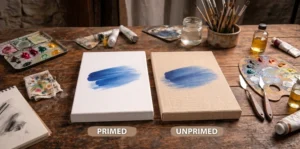
Raw linen, cotton canvas, and wood panels all have different levels of absorbency. Without appropriate surface preparation, painting directly on these materials can cause the binder in the paint to penetrate too deeply into the substrate, affecting both color appearance and painting feel.
One coat of gesso can provide an initial layer of preparation, but it may not provide sufficiently even coverage or achieve the level of opacity, absorbency, and surface texture you want.
The purpose of applying multiple thin coats is that each layer can further improve the coverage and condition of the surface. As the layers build up, they create a more even painting surface.
If you want a smoother surface, you can lightly sand the surface after each coat has dried completely before applying the next one. This is why practical application usually emphasizes multiple thin coats rather than applying one thick coat at once. A single overly thick coat not only takes longer to dry but may also increase the risk of problems such as cracking.
Different Painting Media Require Different Numbers of Coats
Acrylic and oil paints have different requirements for the painting ground, which also affects how many coats of gesso you may need.
| Painting Medium | Recommended Coats | Reason |
|---|---|---|
| Acrylic painting | 1–2 coats | Acrylic paint is relatively flexible in terms of surface requirements, and 1–2 coats are usually enough to create a suitable painting surface. |
| Oil painting | 2–4 coats | Oil painting generally benefits from more thorough and even surface preparation. When acrylic gesso is used as the ground for oil painting, many products recommend 2–4 coats, with sanding between coats if needed. |
| Traditional gesso / Classical painting techniques | Depends on the specific system and desired surface | Traditional gesso is not the same material system as modern acrylic gesso. It is typically applied in multiple thin coats with sanding to achieve a smoother surface, so it is not advisable to summarize it with one fixed number of coats. |
These numbers are only common guidelines, not strict rules. Around three coats is a common average approach, but even with the same painting medium, the required number of coats can vary depending on the absorbency of the substrate and whether you want to preserve more of the canvas texture.
For oil painting, pay particular attention to drying and curing time. If you use acrylic gesso as the ground, make sure the final coat has dried and cured sufficiently before beginning to paint with oils. Always follow the specific drying and curing recommendations provided by the gesso manufacturer.
Different Substrates Make a Big Difference
The absorbency and surface condition of the substrate itself can affect how many additional coats of gesso you need.
Raw Canvas
Raw canvas, including untreated linen or cotton canvas, is generally quite absorbent. The number of coats should be determined according to the openness of the canvas weave and the surface effect you ultimately want.
The more pronounced the canvas texture, the more coats of gesso and appropriate sanding you will generally need if you want a smoother surface.
Wood Panels and Other Rigid Surfaces
Wood panels, hardboard, and birch panels are generally more dense than untreated fabric, but they still require appropriate surface preparation according to the specific material and the manufacturer’s instructions.
With wood panels, the edges should also be treated to help reduce the effects of moisture and environmental changes on the panel.
Pre-Primed Canvas
Pre-primed canvas is the type of canvas you can purchase from an art supply store that has already been prepared with a ground. These products can usually be painted on directly without applying gesso from scratch.
If you feel that the surface is not smooth enough or you want to adjust the background color, you can add one or more coats of gesso according to the product’s compatibility and your individual needs.
However, before doing so, it is best to check which painting media the manufacturer specifies the canvas is suitable for.
The Surface Texture You Want Also Determines the Number of Coats
In addition to the painting medium and substrate, your painting style and the surface effect you want are also important factors to consider.
For Expressive or Textured Painting
If you create expressive or abstract works with strong brushstrokes and want to preserve the natural texture of the canvas, you generally do not need to keep adding gesso coats simply to achieve a completely smooth surface.
Fewer coats of ground, or even using a suitable pre-primed canvas directly, can preserve more of the canvas texture and surface character.
For Highly Detailed or Realistic Painting
If you create highly realistic paintings, detailed works, or paintings involving transparent glazing that require delicate transitions, you will generally prefer a smoother ground.
You can increase the number of gesso coats and lightly sand the surface after it has dried completely, gradually reducing the surface texture.
In this situation, the smoothness of the surface can affect how the brush feels when you are working on fine details and creating color transitions.
So, more gesso is not necessarily better. What really matters is finding the right balance for your painting medium, substrate, and painting style.
How to Apply Gesso Properly: Technique Matters More Than the Number of Coats
The number of coats is only one factor. What really determines the quality of the ground is how you apply those coats.
1. Apply Thin Coats
After squeezing out the gesso, you can add a small amount of water to adjust its flow if the product instructions allow it. However, do not over-dilute it simply to make it easier to apply.
Use a wide brush to spread a thin, even layer over the surface. It is completely normal for the first coat to look patchy or uneven. There is no need to worry—the following coats will gradually improve the coverage.
2. Change the Brushing Direction
Consider changing the direction of each coat. Apply the first coat horizontally, the second vertically, and the third horizontally again.
Alternating the direction can help create more even coverage and reduce noticeable brush marks.
3. Sand When You Want a Smoother Surface
After each coat has dried completely, you can use suitable fine-grit sandpaper to lightly sand away brush marks and small particles. Then remove the surface dust before applying the next coat.
If you want to preserve the natural canvas texture and tooth, you do not necessarily need to sand between every coat.
4. Allow Enough Drying Time
Gesso can often become surface-dry within a relatively short period, but drying speed varies depending on the product, temperature, humidity, and coating thickness.
Some products may become touch-dry in approximately 1–2 hours, but you should follow the manufacturer’s instructions and allow sufficient time before painting.
If acrylic gesso is being used as a ground for oil painting, drying and curing time is particularly important, as some professional products recommend waiting several days after the final coat to allow more complete curing.
Common Questions
Do You Always Need to Sand Gesso?
If you want a rougher, more textured surface, you can reduce sanding or even skip it altogether, allowing the texture of the canvas and gesso to remain.
However, if you want a smoother surface, sanding can be very helpful. Whether you need to sand after every coat can be determined by the final surface effect you want to achieve.
Can You Apply Colored Gesso Over a Pre-Primed Canvas?
Yes, you can.
Many artists like to apply a layer of gray, beige, or black gesso over a pre-primed canvas as a colored ground. This means they do not have to start painting from a pure white surface and can have greater control over the light and dark relationships in the painting.
Usually, one coat can be a good starting point for changing the background color, but additional coats can be applied if better coverage is needed.
What Happens If You Apply Too Much Gesso?
In theory, more ground is not necessarily better.
Too many or overly thick layers can change the absorbency and tooth of the surface and increase drying time. If a single coat is applied too thickly, it may also increase the risk of problems such as cracking.
Therefore, rather than aiming for a fixed number of coats, it is better to determine the appropriate amount according to the substrate, the product instructions, and the surface effect you ultimately want.
A Simple Summary
For most painting applications, 2–3 thin coats are a common starting point. Acrylic painting usually requires 1–2 coats, while oil painting typically requires 2–4 coats.
For highly realistic painting, you can create a smoother surface by increasing the number of gesso coats and sanding appropriately. If you purchase a pre-primed canvas, you can usually paint on it directly.
When applying gesso, remember to apply thin coats, change directions appropriately, sand when necessary, and allow sufficient drying time.
Most importantly, follow the instructions for the specific product you are using. This will make it easier to create a ground that suits your particular painting needs.