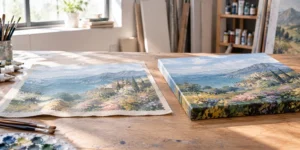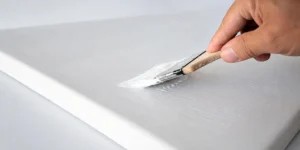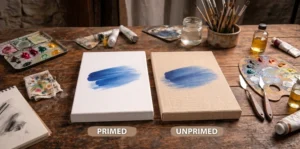
In most cases, you don’t need to spray your canvas with water before painting. For acrylic painting, lightly dampening the surface can sometimes help colors spread more naturally. For cotton or linen canvases that have become loose over time, lightly spraying the back may also help tighten the fabric. These two techniques serve different purposes: one changes how the paint behaves, while the other helps adjust canvas tension. When painting with oils, it’s generally best to keep the canvas surface dry.
Why Do Some Acrylic Painters Wet Their Canvas First?
Acrylic paint dries relatively quickly, especially in hot, dry conditions or when you’re working on a large area. When you’re painting a soft sky gradient, a blurred background, or a smooth transition between colors, paint that dries too quickly can make blending more difficult.
Lightly dampening the canvas can sometimes change how the paint spreads and flows, creating softer transitions. However, it does not necessarily extend the drying time of acrylic paint. If your main goal is to keep the paint workable for longer, consider using a slow-drying medium designed for your acrylic paint.
Some artists also use a damp canvas to create watercolor-like staining effects, allowing diluted acrylic paint to flow and spread naturally across the surface. This technique is better suited to loose, fluid, or abstract styles than to everyday acrylic painting. If you want to try it, test the technique on a small canvas or scrap piece first to see how the colors behave.
Why Is Spraying Water Usually Unnecessary for Oil Painting?
Oil paint uses drying oils as its binding medium, so it behaves differently from water-based paint. Spraying water onto the canvas before painting does not improve the adhesion of oil paint and may interfere with how the paint spreads and feels during application. For this reason, it is generally unnecessary. More importantly, the canvas should be properly primed for oil painting and have a dry, suitable painting surface.
If you want oil paint to spread more smoothly, you can use an appropriate painting oil or medium as needed.
There is also a common point of confusion worth clearing up: the oil painting technique known as wet-on-wet has nothing to do with spraying water onto the canvas. It means applying fresh oil paint over a layer that is still wet, allowing colors to blend and transitions to form within the wet paint.
Should You Wet Your Canvas? A Quick Guide
| Painting Situation | Should You Spray Water First? | What to Know |
|---|---|---|
| Regular acrylic painting | Usually not necessary | You can paint directly onto a dry, primed canvas. |
| Acrylic staining, pouring, or fluid effects | You can try lightly dampening it | Colors may spread more naturally and develop softer edges. |
| Watercolor on a standard primed canvas | Spraying alone won’t solve the problem | Standard acrylic- or oil-primed canvases are generally unsuitable for traditional watercolor. Use a watercolor canvas or an appropriate watercolor ground. |
| Oil painting | Usually not necessary | Keep the surface dry and use a primer suitable for oil painting. |
| Impasto, dry-brush techniques, or crisp edges | Usually not necessary | A dry surface generally makes it easier to control brushstrokes and build up paint texture. |
| Canvas panels with a rigid board backing | Usually not necessary | Avoid unnecessary moisture, which may cause the backing material to swell or warp. |
| A finished painting on a loose canvas | Don’t spray the front of the painting | Identify the cause of the looseness before deciding how to address it. |
How Much Water Should You Spray?
Start with a Light Mist
If you’re experimenting with acrylic staining or soft, blended effects, start with a very light mist. Use a clean spray bottle and apply the water from a short distance, distributing it evenly across the surface rather than repeatedly spraying one spot.
The canvas should not have visible puddles or large droplets of water. The more water you add, the harder it can be to predict how the paint will flow and spread. Excess moisture may also blur brushstrokes that you intended to keep crisp. If you want sharp edges and consistent color coverage, painting directly onto a dry canvas is often easier to control.
Avoid Repeated Spraying During Painting
You also don’t need to keep spraying the canvas throughout your painting session just to stop acrylic paint from drying. If the paint has already started to dry, repeated misting may disturb the layers you’ve applied. If you need more time to blend colors, an appropriate slow-drying medium is usually a better option than repeatedly adding water to the canvas.
What Happens If You Use Too Much Water?
Spraying water does not automatically damage an acrylic painting, but too much moisture can make the painting process harder to control. Paint may spread farther than expected, and edges may become blurred. Adding excessive amounts of water directly to acrylic paint can also affect its coverage, dried appearance, and film durability.
Be especially careful with canvas panels. Their backing may contain cardboard or other moisture-sensitive materials. If these absorb too much water, they can swell, warp, or become distorted.
Important: If you’re working on a painting that is already underway or finished, avoid spraying water directly onto the painted surface just to change its appearance. Moisture may disturb paint that has not fully dried and can sometimes leave uneven marks on the surface.
A Related Question: How Can You Tighten a Loose Canvas?
Over time, a stretched canvas may become slack, develop a slight bulge in the center, or lose its smooth, taut surface. In some cases, lightly spraying the back of the canvas and allowing it to air-dry can help restore tension. Cotton and linen fibers swell when exposed to moisture, and the fabric may become tighter again as it dries.
If the canvas already has a finished painting on it, spraying the back still requires caution, and you should first assess the condition of the canvas and paint layers. If the painting is only slightly loose, start by checking the stretcher frame and its corner keys. If the paint is cracking or lifting, or the artwork has significant monetary or sentimental value, seek advice from a professional art conservator.
Before You Start Painting, Try a Simple Test
If you’re unsure whether pre-wetting will work for your painting style, try a simple comparison on a spare piece of canvas. Apply one brushstroke to a dry, primed surface and another to a lightly dampened one. Compare how the paint spreads, how clearly the edges hold, and whether the resulting brushstrokes match the effect you want.
If you notice little difference between the two, there’s no need to add water. If you’re experimenting with acrylic staining or soft color transitions, pre-wetting may be a useful technique.
In short, most paintings can be started directly on a dry canvas. Only consider pre-wetting when you specifically want the effect that a damp surface can create. Understand the result you’re aiming for first, then decide whether adding water will help.