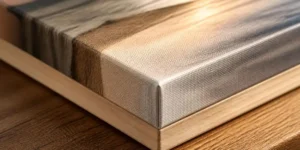
Polyester canvas is a synthetic canvas fabric made primarily from polyester fibers. It offers good strength, dimensional stability, and low moisture absorption. Polyester canvas designed for digital printing is usually treated with a specialized surface coating to accommodate different ink systems and printing requirements. It is widely used for digital printing, photo canvas production, decorative wall art, and certain DIY creative projects.
How Is Polyester Canvas Made?
The manufacturing process of polyester canvas generally involves several stages, from fiber production to fabric finishing and quality inspection.
1. Polyester Fiber Production
Polyester fibers are produced primarily from PET (polyethylene terephthalate) through polymerization and melt-spinning processes. Depending on the intended application, either continuous filaments or staple fibers can be used.
2. Yarn Processing
The polyester fibers are processed into yarn suitable for weaving. Yarn thickness, structure, and processing methods all influence the final canvas’s weight, texture, and strength.
3. Weaving
The polyester yarns are interlaced in warp and weft directions to form the canvas base fabric. Different weaving structures create different surface textures and physical properties.
4. Surface Treatment and Coating
The base fabric undergoes appropriate surface treatments depending on its intended application.
For digital inkjet printing, a specialized inkjet coating is usually applied to improve ink reception, color reproduction, and image clarity. For hand-painting applications, the canvas requires suitable priming or surface preparation based on the type of paint being used.
5. Finishing and Quality Inspection
After coating and finishing, the canvas is inspected for weight, width, surface condition, and other relevant properties. It is then converted into rolls or other required formats.
It is important to distinguish between the polyester base fabric and the inkjet coating. The base fabric mainly determines the material’s fundamental physical properties, while the coating plays a major role in determining its suitability for specific printing applications.
Main Types of Polyester Canvas
Based on fiber composition, polyester canvas can generally be divided into two categories:
- 100% Polyester Canvas: Made primarily or entirely from polyester fibers, offering the characteristic properties of synthetic polyester materials.
- Polyester-Cotton Blended Canvas: Made by combining polyester and cotton fibers in specific proportions, incorporating characteristics of both synthetic and natural fibers.
What Are the Main Properties of Polyester Canvas?
The performance of polyester canvas depends on the fiber itself, weaving structure, and subsequent finishing processes. Compared with traditional cotton canvas, it offers several advantages in certain applications.
Good Dimensional Stability
Polyester fibers have relatively low moisture absorption and are generally less affected by changes in environmental humidity than natural cotton fibers.
As a result, polyester canvas typically offers good dimensional stability, helping it maintain consistent dimensions during printing, cutting, stretching, and other finishing processes.
For printing businesses and decorative canvas manufacturers handling large production volumes, consistent material performance can help improve production efficiency and processing consistency.
Good Strength and Abrasion Resistance
Polyester fibers offer good tensile strength and abrasion resistance. When properly woven, polyester canvas can meet the requirements of many digital printing and decorative canvas applications.
However, the actual strength of canvas depends on more than just fiber composition. Yarn specifications, weaving density, fabric weight, and finishing processes also play important roles.
Low Moisture Absorption
Compared with cotton fibers, polyester fibers absorb less moisture. This means polyester canvas is generally less likely to undergo noticeable changes caused by fiber moisture absorption in humid environments.
However, low moisture absorption does not mean that all polyester canvas products are waterproof. Ordinary polyester base fabric, coated inkjet canvas, and specially waterproof-treated materials can have significantly different water resistance properties.
Polyester Canvas vs. Cotton Canvas
Polyester canvas and cotton canvas are two commonly used materials in the digital printing and art materials industries. Neither is universally better than the other. Their main differences lie in fiber characteristics, surface texture, and suitable applications.
| Comparison | Polyester Canvas | Cotton Canvas |
|---|---|---|
| Raw Material | Synthetic polyester fibers | Natural cotton fibers |
| Moisture Absorption | Low | Relatively higher |
| Dimensional Stability | Generally good | More affected by humidity changes |
| Wrinkle Resistance | Generally better | More prone to creasing |
| Surface Texture | Can be adjusted through weaving and coating | Natural cotton fiber texture |
| Painting Feel | Depends on priming and surface treatment | Widely used in traditional painting |
| Common Applications | Digital printing, photo canvas, decorative wall art, and some DIY projects | Traditional oil painting, acrylic painting, artistic creation, and professional art printing |
If your primary requirements are digital printing, mass production of decorative canvas, or consistent dimensional performance, polyester canvas is worth considering.
If you place greater importance on natural fiber texture, the traditional feel of painting surfaces, and artists’ established preferences, cotton canvas may be a better choice.
Polyester-cotton blended canvas combines characteristics of both fibers. However, its actual performance depends on the blending ratio and weaving process. It should not automatically be considered superior to either pure cotton or 100% polyester canvas.
Coatings, GSM, and Surface Finishes of Polyester Canvas
For polyester canvas used in digital printing, the base fabric determines the basic material structure, while the surface coating directly affects ink reception and the final printing results.
Surface Coatings
Ordinary polyester fabric without specialized treatment may not produce satisfactory inkjet printing results. Therefore, digital inkjet canvas usually requires a coating formulated according to the ink system and printing requirements.
The coating affects not only ink absorption and adhesion but also image clarity, color reproduction, drying time, and surface feel.
Different applications may require different surface treatments. For example, digital inkjet canvas needs to provide suitable ink reception and image quality, while hand-painting canvas requires appropriate paint adhesion and painting characteristics.
Fabric Weight (GSM)
Fabric weight is usually measured in GSM (grams per square meter), indicating the weight of one square meter of material. It is one of the important specifications used to evaluate canvas products.
Polyester printing canvas is available in various weights, such as 200gsm, 240gsm, 260gsm, and 280gsm. However, the actual thickness, stiffness, and feel of a canvas are also influenced by yarn specifications, weaving density, and coating weight.
In general:
- Lightweight canvas: Easier to handle and transport in roll form, and suitable for certain printing applications.
- Medium-weight canvas: Commonly used for standard art printing and decorative canvas production.
- Heavier canvas: Usually offers a more substantial feel and can be selected according to stretching and display requirements.
Higher GSM does not necessarily mean better quality. When choosing polyester canvas, consider printer feeding capabilities, canvas width, stretching methods, and the intended application.
Surface Finishes
Depending on the coating formulation and finishing process, polyester canvas can be produced with different textures and gloss levels, including:
- Matte: Offers low surface reflection and is suitable for many art printing and decorative applications.
- Semi-Matte: Provides a balance between surface gloss and glare control.
- Glossy: Features a more noticeable shine and is suitable for prints that require a glossy appearance.
Different finishes suit different image styles and display environments.
Which Printing Inks Are Compatible with Polyester Canvas?
Ink compatibility is an important consideration for digital printing businesses when selecting polyester canvas.
Not all polyester canvas products are compatible with every type of printing ink. Even when the same polyester base fabric is used, different coating formulations can produce different printing results.
Common printing ink systems include:
Water-Based Dye and Pigment Inks
Water-based dye and pigment inks are widely used for photo printing, art printing, and certain decorative canvas applications.
Dye-based and pigment-based inks have different characteristics and coating requirements. When selecting water-based inkjet canvas, confirm that the product is compatible with the intended ink type. Actual printing tests should also be conducted to evaluate color reproduction, drying time, and ink adhesion.
Eco-Solvent Inks
Eco-solvent inks are commonly used in large-format digital printing equipment.
Polyester inkjet canvas designed for this printing system requires a suitable surface coating to provide appropriate ink reception and image quality.
UV and Latex Inks
UV and Latex printing systems have different substrate requirements compared with conventional water-based and eco-solvent printing.
When using these systems, select materials specifically designed and tested for the relevant printing technology. Ordinary inkjet-coated canvas should not be assumed to be compatible with all UV or Latex printers.
Purchasing Tip: Before placing a bulk order, confirm the printer model, ink system, and canvas coating type. Conduct actual printing tests and evaluate image details, color reproduction, drying performance, ink adhesion, and subsequent finishing results.
What Are the Common Uses of Polyester Canvas?
Polyester canvas can be adapted to various printing and creative applications through different weaving structures and surface coatings. Its common uses can be grouped into several categories based on the final product and intended application.
Digital Printing and Commercial Graphic Output
Polyester canvas with a specialized inkjet coating can be used for commercial image printing, promotional displays, customized graphic output, and bulk printing projects.
Its roll format makes large-format printing, cutting, and subsequent processing more convenient, making it suitable for printing service providers and decorative canvas manufacturers.
Photo Canvas and Home Decor
Polyester canvas is also used for photo printing, personalized wall art, and decorative products for commercial spaces.
After printing, the canvas can be cut and stretched over wooden frames according to the product design, creating decorative wall art suitable for living rooms, bedrooms, offices, and other indoor spaces.
Fine Art Printing and Artwork Reproduction
Fine art printing and artwork reproduction require higher standards for color accuracy, image detail, ink compatibility, and long-term print stability.
Cotton, polyester-cotton blended, and cotton-linen canvases are all used in this field. Polyester canvas with professionally engineered coatings and proven performance can also be suitable for certain high-quality art printing applications. However, ordinary polyester inkjet canvas should not automatically be considered equivalent to professional fine art canvas.
DIY Art and Creative Projects
With appropriate surface treatment, polyester canvas can also be used in selected DIY and creative projects, such as personalized decorative paintings, handmade art projects, and other canvas-based crafts.
Its suitability for hand-painting or other creative techniques depends on the surface preparation and the specific requirements of the intended application.
What Are the Disadvantages of Polyester Canvas?
In addition to understanding the advantages of polyester canvas, it is also important to consider its limitations.
Less Natural Fiber Texture
As a synthetic fiber material, polyester canvas generally lacks some of the natural feel and texture associated with cotton fibers.
For artists who particularly value the traditional texture of natural painting materials, cotton canvas may better match their preferences.
Suitability for Hand-Painting Depends on Surface Treatment
Polyester base fabric is not automatically suitable for every type of painting. Oil and acrylic painting generally require appropriate priming and surface preparation to ensure paint adhesion and satisfactory painting results.
If a product was originally designed for digital inkjet printing, it should not automatically be treated as professional hand-painting canvas.
Lower Moisture Absorption
Polyester fibers have lower moisture absorption than cotton fibers. While this contributes to dimensional stability, polyester canvas does not offer the same moisture-absorbing characteristics as natural cotton canvas.
For applications where natural material feel and moisture absorption are important considerations, cotton canvas may be a more suitable option.
Environmental Impact Depends on Raw Materials and Production Methods
Polyester fibers are generally derived from petrochemical raw materials. The recycling and disposal of conventional polyester materials require consideration of their environmental impact.
Recycled polyester fibers are also available. However, the use of recycled materials, their actual content, and any related certifications should be verified through supplier documentation.
How to Choose the Right Polyester Canvas
When purchasing polyester canvas, it is not advisable to make a decision based on price or GSM alone. The first step is to identify the intended application and then evaluate the relevant material specifications.
If You Need Polyester Canvas for Digital Printing
Pay attention to the following factors:
- Fiber Composition: Confirm whether the product is 100% polyester or polyester-cotton blended canvas, and check the exact fiber composition.
- Ink Compatibility: Make sure the coating is suitable for the intended water-based, eco-solvent, or other printing ink system.
- GSM and Weaving Structure: Choose the appropriate weight and fabric construction according to printer feeding requirements, roll processing, cutting, and stretching needs.
- Surface Finish: Select matte, semi-matte, or glossy finishes according to the image style and display environment.
- Printing Performance: Conduct actual printing tests to evaluate image details, color reproduction, drying time, and ink adhesion.
- Post-Printing Performance: If the canvas will be stretched or used for bulk framing, further test its stretching, folding, wrapping, and fastening performance.
If You Need Polyester Canvas for Hand-Painting
If polyester canvas is intended for oil painting, acrylic painting, or other hand-painting projects, check the following:
- Whether the surface has been properly primed for hand-painting.
- Whether the paint can adhere properly to the canvas surface.
- Whether the fabric texture and surface feel meet the artist’s requirements.
- Whether the product is suitable for the intended painting technique.
Do not confuse digital printing coatings with hand-painting primers. They are designed for different purposes and have different performance requirements.
If You Are Purchasing in Bulk
For printing businesses, wholesalers, and decorative canvas manufacturers, material specifications are only part of the purchasing decision.
Other important factors include consistency between production batches, roll packaging, supply capacity, and customization services.
Before placing a bulk order, request samples and test them using your own printers and inks to confirm that the material is suitable for your actual production process.
Frequently Asked Questions About Polyester Canvas
Is Polyester Canvas Suitable for Outdoor Use?
Some specially designed polyester materials can be used in outdoor applications. However, ordinary indoor inkjet canvas should not automatically be considered suitable for outdoor use.
Outdoor applications also require consideration of coating weather resistance, ink lightfastness, water resistance, UV exposure, and actual environmental conditions.
Can Polyester Canvas Be Used for Oil or Acrylic Painting?
Yes. Polyester canvas that has been properly treated and specifically designed for hand-painting can be used for oil or acrylic painting.
However, inkjet coatings designed for digital printing are not equivalent to the primers required for oil or acrylic painting. Always confirm that the product is suitable for the intended paint and painting technique.
Is Higher GSM Polyester Canvas Always Better?
No. A higher GSM generally means a heavier material, but it is not necessarily suitable for every printer or application.
When selecting polyester canvas, consider thickness, weaving density, coating, printer feeding capabilities, and final stretching or framing requirements.
Conclusion
Polyester canvas is a canvas material made primarily from polyester fibers. It offers good strength, dimensional stability, and wrinkle resistance, making it widely used for digital printing, photo canvas, decorative wall art, and selected DIY creative projects.
However, its actual performance depends not only on fiber composition but also on weaving structure, fabric weight, surface coating, and ink compatibility. For printing businesses and wholesalers, selecting the right specifications and coating type is more important than simply comparing material prices or GSM.